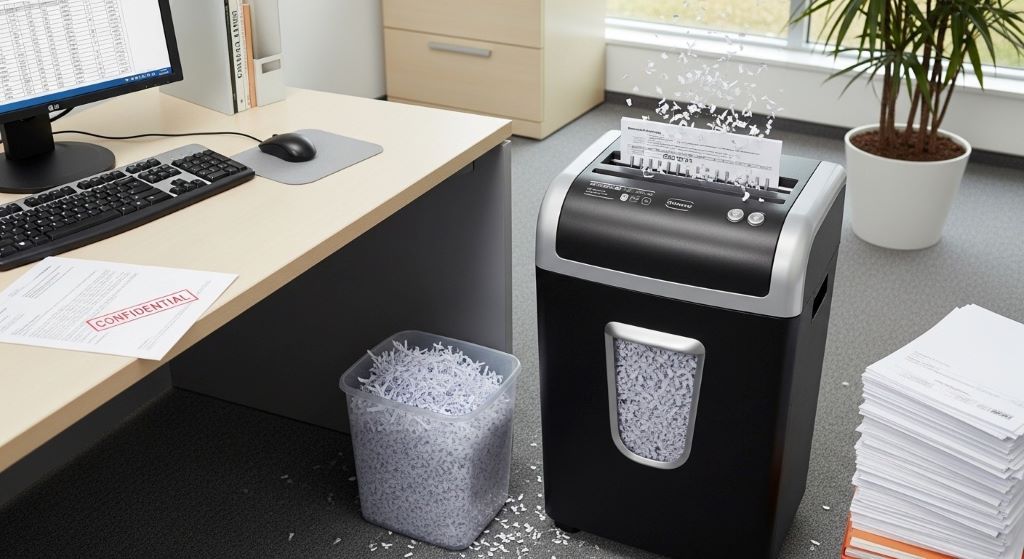

Choosing the right shredder for your office involves more than picking the first model you see. Security matters, especially when handling sensitive documents. Understanding shredder security levels helps protect your business from data breaches and ensures compliance with privacy regulations. This guide will walk you through everything you need to know about selecting the appropriate security level for your workplace needs.
Why Shredder Security Levels Matter
Every office handles confidential information. Employee records, financial statements, client data, and strategic plans all require proper disposal. Simply tossing documents in the trash creates risks. Identity thieves and competitors can retrieve discarded papers and exploit the information they contain.
Security levels determine how thoroughly a shredder destroys documents. Higher levels create smaller particles, making reconstruction virtually impossible. However, more secure shredders typically cost more and take longer to process materials. Therefore, matching your security needs with the right level saves money while protecting sensitive information.
Understanding the DIN 66399 Standard
The DIN 66399 levels provide an international framework for document destruction. This German standard replaced older classification systems in 2012 and has become the global benchmark. The standard covers various materials, including paper, optical media, and hard drives.
The classification system uses letters and numbers. Letters indicate the material type, while numbers represent security levels. For paper documents, the designation starts with P, followed by a number from 1 to 7. Each level specifies maximum particle size and surface area requirements.
Understanding this standard helps you communicate clearly with vendors and ensures your shredder meets industry requirements. Moreover, many compliance regulations reference these security levels directly.
Breaking Down Security Levels for Paper Documents
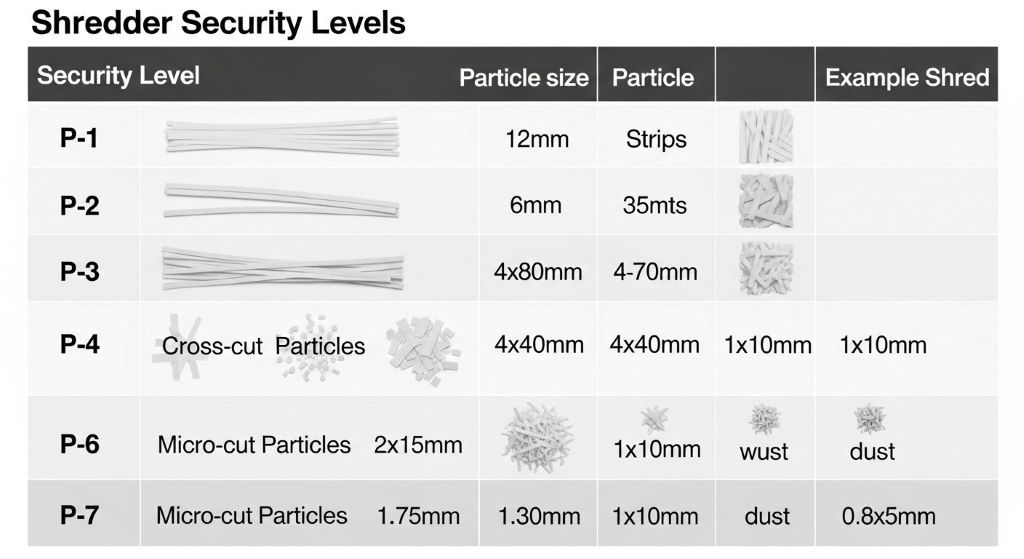
Level P-1 provides basic security suitable only for general documents with no confidential information. These shredders create strips roughly 12 millimeters wide. Office newsletters or outdated promotional materials fit this category.
Level P-2 offers slightly better protection with 6-millimeter strips. Internal documents with minimal sensitivity work at this level. However, most offices need higher security for day-to-day operations.
Level P-3 represents the minimum for confidential business documents. Shredders at this level create particles approximately 320 square millimeters in size. Financial records, personnel files, and client correspondence typically require at least this protection level.
Level P-4 handles sensitive documents requiring heightened security. The maximum particle size drops to 160 square millimeters. Many organizations choose this level for standard confidential materials. Tax documents, medical records, and legal papers often need P-4 destruction.
Level P-5 provides high security for highly confidential materials. Particles shrink to just 30 square millimeters. Government contractors, financial institutions, and healthcare providers frequently use this level. The P-4 vs P-5 shredder comparison often comes down to regulatory requirements and the sensitivity of handled information.
Level P-6 and P-7 offer top-secret and maximum security. These levels typically serve military, intelligence, and highly specialized applications. Most commercial offices never need this degree of protection.
Assessing Your Office’s Security Requirements
Start by inventorying the documents your office handles. Create categories based on sensitivity levels. Consider what would happen if each type of document fell into the wrong hands.
Personal information about employees requires careful handling. Social security numbers, addresses, and salary details need robust protection. Similarly, client data demands high security to maintain trust and comply with privacy laws.
Financial records present another critical category. Bank statements, credit card information, and transaction records must be thoroughly destroyed. Additionally, strategic business plans and proprietary research require strong security measures.
Regulatory requirements often dictate minimum security levels. Healthcare offices must follow HIPAA guidelines, which typically require P-4 level destruction or higher. Financial institutions face similar mandates under various banking regulations. Furthermore, the Federal Trade Commission recommends appropriate document destruction for all businesses.
Comparing Shredder Types and Their Security Applications
Strip-cut shredders create long strips from documents. These machines work quickly and handle high volumes efficiently. However, they typically offer lower security levels, usually P-2 or P-3. Office environments with mostly non-confidential materials might find these adequate.
Cross-cut shredders slice paper both horizontally and vertically. This creates smaller particles and provides better security. Most cross-cut models fall into P-3 or P-4 categories. These machines balance security and practicality for general office use.
Micro-cut shredders produce the smallest particles. These devices achieve P-5, P-6, or even P-7 levels. They work more slowly and cost more than other types. Nevertheless, organizations handling highly sensitive information consider them essential.
Evaluating the P-4 vs P-5 Shredder Decision
The choice between P-4 and P-5 security often puzzles office managers. Both levels provide strong protection, yet they differ in important ways.
P-4 shredders create particles up to 160 square millimeters. This level suits most confidential business documents. Processing speed remains reasonable, and prices stay moderate. For standard office confidentiality needs, P-4 delivers excellent value.
P-5 shredders reduce particles to just 30 square millimeters. This dramatic size reduction makes document reconstruction essentially impossible. However, the shredding process takes longer and machines cost significantly more. Maintenance requirements also increase with higher security levels.
Consider your actual risk level when making this decision. Does your office handle information that could cause serious harm if exposed? Do you work in a regulated industry with specific requirements? The answers guide your choice.
Many organizations find P-4 perfectly adequate for routine confidential documents. Meanwhile, they might reserve P-5 or higher for truly sensitive materials. This tiered approach optimizes both security and budget.
Capacity and Volume Considerations
Shredder capacity affects productivity significantly. Small personal shredders handle a few sheets at once, while departmental models process dozens simultaneously. Match capacity to your office’s daily shredding volume to avoid bottlenecks.
Run time matters too. Budget shredders often need frequent cooling breaks. This becomes frustrating in busy offices. Commercial-grade machines run continuously for extended periods, maintaining workflow efficiency.
Bin size determines how often you empty the shredder. Larger bins reduce interruptions but take up more space. Consider your office layout and maintenance preferences when evaluating this feature.
Additional Features That Enhance Security
Automatic feeding systems let you load documents and walk away. The shredder processes everything without supervision. This feature saves time while ensuring consistent destruction quality.
Jam prevention technology reduces frustration and downtime. Sensors detect overfeeding and stop the machine before problems occur. Some models even reverse automatically to clear minor jams.
Safety features protect users from accidents. Automatic shutoffs activate when hands get too close to the feed opening. Child locks prevent unauthorized use, particularly important in shared spaces.
Noise levels vary considerably among shredders. Quiet operation becomes valuable in open office environments. Nobody wants disruptive grinding sounds interrupting phone calls or meetings.
Maintaining Your Shredder for Optimal Security
Regular maintenance keeps shredders functioning properly. Oil the cutting blades according to manufacturer recommendations. This prevents jamming and extends machine life.
Empty bins before they overflow. Overfilled containers can jam the mechanism or reduce cutting efficiency. Some high-security shredders require more frequent emptying due to smaller particle sizes.
Inspect shredded materials periodically. Particles should match the security level specifications. If you notice larger pieces or incomplete destruction, service the machine immediately.
Cost Considerations and Long-Term Value
Initial purchase price represents just one cost factor. Consider supplies, maintenance, and energy consumption over the shredder’s lifespan. Higher security models often have greater operating costs.
However, security breaches can prove far more expensive than premium shredders. Calculate the potential cost of exposed confidential information. Legal fees, regulatory fines, and reputation damage often dwarf equipment expenses.
Leasing programs offer alternatives to outright purchase. Monthly payments spread costs over time while including maintenance and service. This approach works well for organizations wanting to avoid large capital expenditures.
Industry-Specific Recommendations
Healthcare facilities should prioritize P-4 or P-5 levels for patient records. HIPAA compliance demands thorough document destruction. Additionally, consider shredders that handle prescription bottles and pill packaging.
Legal offices deal with highly confidential client information. P-4 minimum security protects attorney-client privilege effectively. Larger firms might opt for P-5 on particularly sensitive cases.
Financial institutions face strict regulatory oversight. Banking documents typically require P-4 security at minimum. Investment firms handling merger information or insider trading concerns might need P-5 protection.
Small businesses often underestimate their security needs. Even modest operations handle sensitive information. Customer databases, employee records, and financial statements all deserve proper destruction.
Making the Final Decision
Start by clearly defining your security requirements. List document types and their sensitivity levels. Consult relevant regulations affecting your industry.
Next, evaluate your volume needs. How many pages does your office shred daily? This determines the capacity and duty cycle you need.
Budget plays a crucial role. Balance initial costs against long-term security value. Remember that adequate security costs less than potential breaches.
Read reviews from similar organizations. Real-world experiences reveal strengths and weaknesses that specifications might not show. Pay attention to reliability and customer service feedback.
Test machines when possible. Many vendors offer demonstrations or trial periods. Hands-on experience helps confirm that a model meets your expectations.
Conclusion
Selecting the right security level for your office shredder protects your organization from data breaches and ensures regulatory compliance. Understanding the DIN 66399 levels helps you communicate requirements clearly and make informed decisions. Most offices find P-4 security adequate for confidential documents, while highly sensitive materials might warrant P-5 protection. The P-4 vs P-5 shredder comparison ultimately depends on your specific industry, regulatory requirements, and the nature of documents you handle.
Consider capacity, features, and long-term costs alongside security levels. Match your shredder choice to actual needs rather than choosing the highest security level available. Proper maintenance ensures your shredder continues providing reliable protection. By following this guide, you can confidently select a shredder that balances security, efficiency, and budget constraints effectively.
Frequently Asked Questions
What security level does my office really need?
Most general offices function well with P-3 or P-4 security for confidential documents. If you handle personal information, financial records, or medical data, start at P-4 minimum. Highly regulated industries or particularly sensitive materials might require P-5. Assess your specific documents and industry requirements to determine the appropriate level.
How much slower are higher security shredders?
Higher security levels generally reduce processing speed because machines create smaller particles. P-5 shredders typically operate 20-40% slower than P-4 models. However, technology improvements have narrowed this gap. The security benefits usually outweigh the modest time increase for organizations handling sensitive materials.
Can I use different security levels for different documents?
Absolutely. Many organizations maintain multiple shredders with varying security levels. Use lower-level shredders for general documents and reserve high-security models for sensitive materials. This tiered approach optimizes both cost and efficiency while maintaining appropriate protection for each document type.
How often should I replace my office shredder?
Quality commercial shredders typically last five to ten years with proper maintenance. Replace your shredder when repair costs approach replacement costs, when security standards change, or when capacity no longer meets office needs. Regular servicing extends lifespan significantly.
Does shredder security level affect recycling?
Yes, particle size impacts recycling options. Lower security levels create larger strips that recycle more easily. Higher security micro-cut particles sometimes face recycling challenges. However, many recycling programs now accept all security levels. Check with your local recycling provider about their specific requirements.
Related Topics:
Proven Strategies to Keep Office Sparkling Clean
5 Factors to Consider When Choosing Office Furnitures