

You’ve got the boards, the wax, and the wetsuit. But if you’re driving to the coast without a reliable way to secure your gear, you’re risking more than just a late session. A loose board flying off your car at highway speed is dangerous, expensive, and entirely preventable. The challenge is that the market is flooded with options, and not all of them are built to handle the stress of wind, speed, and vibration. Finding a safe surfboard roof rack isn’t just about strapping foam blocks to your crossbars; it’s about understanding load limits, strap quality, and how your specific vehicle interacts with the gear. This guide breaks down exactly what you need to look for, the mistakes to avoid, and how to make a confident purchase that protects your boards and everyone on the road.
What Defines a Truly Safe Surfboard Roof Rack?
A safe rack system is one that holds your board securely under all driving conditions—including sudden braking, strong crosswinds, and high-speed freeway driving—without damaging the board itself. Safety is a combination of the rack’s structural integrity, the quality of the straps or cams, and the surface that contacts your board.
Many surfers assume that any rack labeled “surfboard” is inherently safe. That is not the case. A rack that works perfectly for a 5’8″ fish on a sedan might be dangerous for a 9’0″ longboard on an SUV. The key is matching the system to your specific needs, which means evaluating several critical components before you ever load a board.
Strap Quality and Tension Mechanism
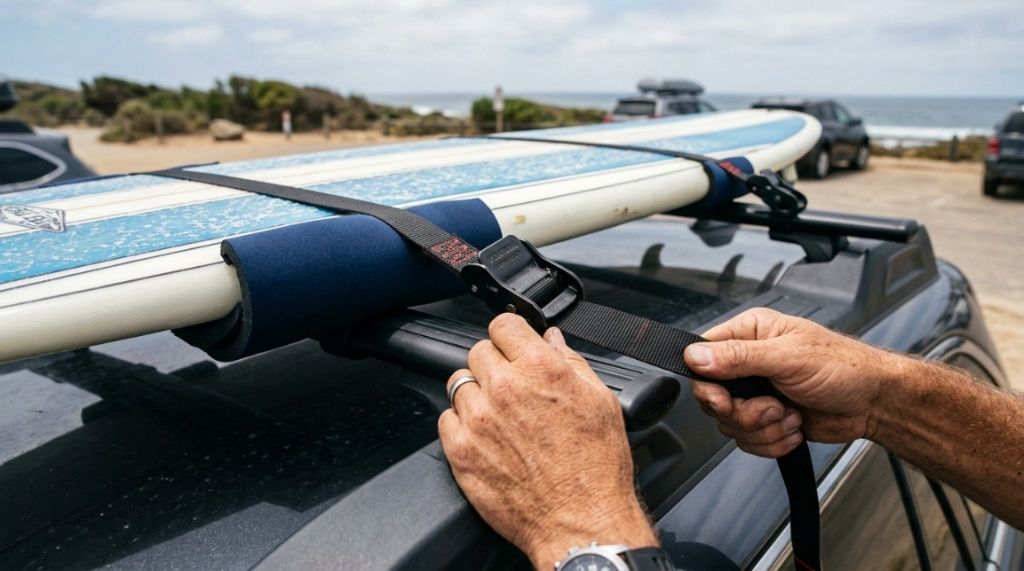
The straps are the most critical safety component. Look for heavy-duty, UV-resistant polyester webbing. Cheap nylon straps degrade quickly in the sun and can snap under tension. The buckle or cam mechanism matters just as much. A ratcheting system offers precise tension but can be over-tightened, potentially cracking a board. A cam buckle is faster but requires you to pull hard enough to secure the board without crushing it. The best systems use wide straps (at least 1.5 inches) with padded sleeves that distribute pressure evenly across the board’s rails.
Contact Points and Board Protection
The contact points—the parts that actually touch your surfboard—must be soft enough to avoid dings but firm enough to prevent movement. Closed-cell foam is the industry standard because it doesn’t absorb water, dries quickly, and provides a non-slip grip. However, the shape of the foam matters. A flat block works for most boards, but a contoured cradle is better for high-performance shortboards with rounded rails. Check that the foam is thick enough to prevent the board from touching any metal parts of the rack system.
Roof Rack Types: Which Design Is Right for You?
There are three primary categories of surfboard roof racks: soft racks (foam blocks with straps), hard racks (metal bars with dedicated surfboard carriers), and tailgate pads (for trucks). Each has distinct advantages and limitations regarding safety.
Soft Racks (Foam and Strap Systems)
Soft racks are the most popular choice for casual surfers or those who don’t want to permanently modify their vehicle. They consist of two foam blocks that sit on your car’s roof, with straps that thread through the door frames or attach to existing crossbars. These are generally safe if installed correctly, but they have a critical limitation: they rely on the tension of the straps against the car’s body. If the straps are not tightened properly, the entire rack can shift at speed. They are also more susceptible to theft since they are easy to remove.
Hard Racks with Surfboard Attachments
Hard racks—either factory-installed or aftermarket crossbars—provide a more stable base. When paired with dedicated surfboard carriers (like the Thule Surf or Yakima Surflink), they offer superior safety. The metal crossbars handle the structural load, while the surfboard attachment provides a secure, padded cradle. This setup is safer for long-distance travel and for carrying multiple boards. The downside is cost and installation complexity, but the safety margin is significantly higher.
Tailgate Pads for Trucks
If you drive a pickup truck, a tailgate pad is often the safest option. These pads drape over the tailgate, protecting the truck’s paint and providing a soft surface for boards to rest on. Straps secure the boards to the pad. This method keeps the boards lower to the ground, reducing wind resistance and making loading easier. However, it is only safe if the boards are strapped down individually and the pad is properly secured to the tailgate. A loose pad can slide off, taking your boards with it.
How to Install Your Rack Correctly to Prevent Accidents
Even the best rack on the market is useless if installed incorrectly. The most common cause of surfboard roof rack failure is user error during installation. Follow these steps to ensure your rack is secure before you pull out of the driveway.
Step-by-Step Installation Guide
- Clean the mounting points: Wipe down the roof or crossbars to remove dust and wax. Dirt creates a slippery layer that reduces friction.
- Position the blocks evenly: Place the foam blocks or carrier cradles so they are equidistant from the center of the roof. They should be positioned to support the board’s weight evenly, usually near the rails but not so close to the nose or tail that the board flexes.
- Thread the straps correctly: For soft racks, the straps go through the interior of the car with the doors open. Close the doors on the straps, ensuring they are not pinched in the latch mechanism. Pull the straps tight from the outside.
- Tighten in a crisscross pattern: Tighten the front strap, then the rear, then go back to the front. This ensures even pressure and prevents the rack from twisting.
- Load the board and secure it: Place the board fin-up or fin-down depending on the rack design. Use the board-specific straps to secure it to the rack. The board should not move more than a few millimeters when you push on it.
- Perform the “shake test”: Grab the board and the rack and shake them vigorously. If there is any significant movement, the straps are too loose. Re-tighten and test again.
Common Installation Mistakes
One of the most frequent errors is over-tightening the straps. While you want the rack secure, crushing the board with excessive force can cause pressure dings or even snap the board in half. Another mistake is placing the rack too far forward or backward, which can create lift at high speeds or interfere with your line of sight. Finally, never tie the board down with standard rope. Rope lacks the flat surface area of a strap and will cut into the foam and the board’s rails.
Weight Limits and Vehicle Compatibility
Every vehicle has a maximum roof load limit, and every rack has a maximum weight capacity. Ignoring these limits is a recipe for disaster. Exceeding the roof limit can damage your car’s roof structure, while exceeding the rack limit can cause the rack to detach.
Before purchasing a rack, check your vehicle’s owner’s manual for the dynamic roof load rating. This is the maximum weight the roof can handle while the car is moving. This number includes the weight of the rack itself. For example, if your car has a 100-pound limit and your rack weighs 10 pounds, you have 90 pounds of capacity for surfboards. A typical shortboard weighs 5-10 pounds, while a heavy longboard can weigh 20-30 pounds. You must account for the weight of multiple boards and the rack hardware.
Hard Rack vs. Soft Rack: A Safety Comparison
Choosing between a hard rack and a soft rack often comes down to budget and vehicle type, but safety should be the deciding factor. The table below outlines the key differences to help you make an informed choice.
| Feature | Soft Rack (Foam Blocks) | Hard Rack (Crossbars + Carrier) |
|---|---|---|
| Structural Base | Relies on strap tension against the car roof | Bolted or clamped to the vehicle’s roof rails |
| Max Speed Stability | Good up to ~65 mph; can shift in high winds | Stable at all legal highway speeds |
| Security (Theft) | Low; easily removed by hand | High; requires tools to remove |
| Board Protection | Good; foam pads are soft | Excellent; dedicated cradles with padded cams |
| Installation Time | 5 minutes | 30-60 minutes (initial setup) |
| Risk of Paint Damage | Moderate; dirt trapped under foam can scratch | Low; mounts attach to rails, not the painted roof |
| Best Use Case | Occasional local trips | Daily driving, long trips, multiple boards |
If you are driving across the state or carrying expensive boards, the hard rack is the safer investment. For a quick trip to a local break, a high-quality soft rack can be perfectly safe. The key is knowing your limits and not pushing a soft rack beyond its capabilities.
Maintenance and Pre-Trip Safety Checks
Surf racks take a beating from sun, salt, and wind. Regular maintenance is essential to ensure the rack remains safe over time. A strap that looks fine at a glance may have micro-fractures from UV exposure that cause it to fail under load.
Before every trip, inspect the straps for fraying, discoloration, or stiffness. Check the foam blocks for cracks or compression. If the foam has flattened out, it no longer provides adequate cushioning. For hard racks, check the torque on the mounting bolts. Vibration can loosen them over time. It is also wise to periodically wash the rack with fresh water to remove salt crystals, which can corrode metal buckles and weaken the webbing.To keep your gear in top condition during coastal trips, make sure you Protect Surfboards from Florida Humidity alongside using proper transport gear.
Frequently Asked Questions
Can I use a surfboard roof rack on a car without crossbars?
Yes. Soft racks are designed specifically for vehicles without crossbars. They use straps that loop through the interior of the car and close in the door frames. However, you must ensure the straps are not pinched in the door latch and that the foam blocks sit flat on the roof.
Is it safe to drive on the freeway with surfboards on the roof?
Yes, if the rack is installed correctly and the boards are secured. You should drive at or below the speed limit and be aware of crosswinds. It is also recommended to remove the boards if you are going to be parked for an extended period, as sun and heat can damage the boards and the straps.
How many surfboards can I safely carry on a roof rack?
This depends on your vehicle’s roof load limit and the rack’s capacity. Most racks can carry 2-3 boards stacked. However, stacking boards increases wind resistance and the risk of damage. It is safer to carry fewer boards than to overload the rack.
Should I put the surfboard fin up or fin down on the rack?
Most racks are designed to carry boards fin-up. This prevents the fins from digging into the rack pad. However, if you have a rack with a center strap, you may need to place the board fin-down to keep it stable. Always follow the manufacturer’s instructions for your specific rack.
Can a surfboard roof rack damage my car’s roof?
Soft racks can damage the paint if dirt or sand gets trapped between the foam and the roof. Hard racks can damage the roof rails if they are over-tightened. To prevent damage, clean the roof before installation and use torque wrenches for hard rack bolts.
Conclusion
Securing your surfboard correctly is not an optional extra; it is a fundamental part of responsible driving. A safe surfboard roof rack protects your investment, your vehicle, and the people around you. Prioritize systems with high-quality straps, durable foam, and a secure mounting mechanism. Take the time to install the rack correctly, check the weight limits, and perform routine maintenance. Whether you choose a simple soft rack for local sessions or a heavy-duty hard rack for road trips, the principles of safety remain the same: secure straps, stable mounting, and regular inspection. By following the guidance in this article, you can drive with confidence, knowing your board is safe and ready for the waves.