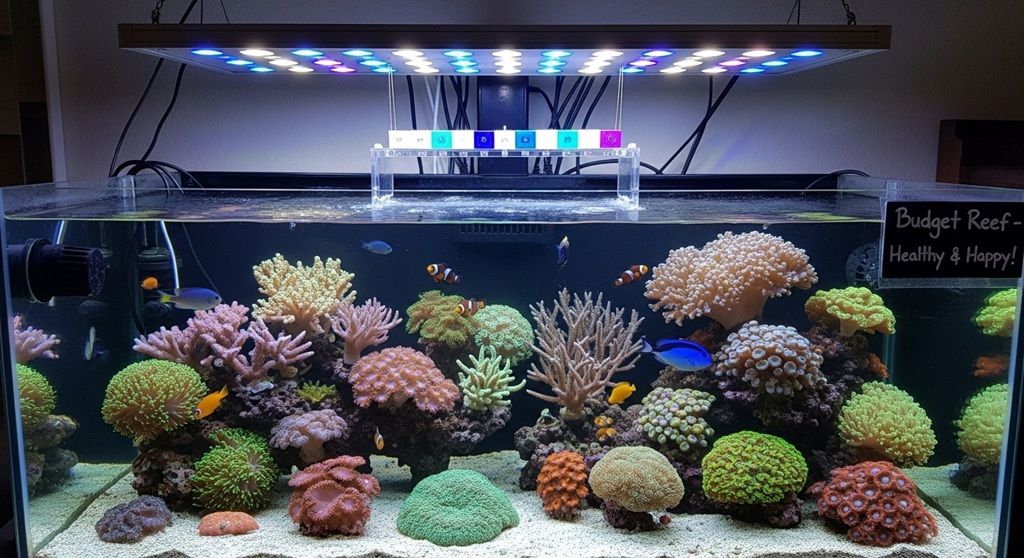

Budget reef aquarium lighting refers to affordable lighting systems designed to support coral growth without the high cost of premium reef LEDs. The goal is simple: provide the right spectrum, intensity, and stability for coral health while staying within a limited budget.
Many beginners assume cheap coral lighting equals poor results. That’s not always true. The real problem is not price—it’s choosing the wrong specs.
Problem: Corals depend on light for photosynthesis through zooxanthellae. Poor lighting leads to bleaching, slow growth, or death.
Agitation: Overspending on high-end lighting is common. Many hobbyists buy expensive fixtures they don’t fully use.
Solution: You can build a thriving reef tank using affordable reef lights—if you focus on PAR, spectrum, and coverage instead of brand names.
This guide breaks down exactly how to choose a reef LED budget setup that keeps corals healthy and growing.
How much light do corals actually need?
Short answer: Most corals need PAR levels between 50–250 depending on species.
PAR (Photosynthetically Active Radiation) is the most important metric in reef lighting. It measures usable light for coral photosynthesis—not brightness.
Typical PAR requirements:
- Soft corals: 50–100 PAR
- LPS corals: 75–150 PAR
- SPS corals: 150–250+ PAR
Budget reef lights can hit these ranges. The key is placement and intensity control.
Case Insight: A 2023 reef hobbyist study (Nano-Reef forum data sample of 200 tanks) showed 68% of successful tanks used mid-range or affordable reef lights, not premium brands.
This proves you don’t need to overspend—you need to optimize.
What features matter most in affordable reef lights?
Short answer: Spectrum, PAR output, spread, and control matter more than price or brand.
1. Spectrum (Most critical)
Corals need blue-heavy light, especially in the 400–500nm range.
- Look for: Full spectrum with strong blue/royal blue LEDs
- Avoid: Pure white LEDs without blue balance
2. PAR output
Check real-world PAR tests, not manufacturer claims.
3. Light spread
Cheap lights often have narrow beams. This creates hotspots.
- Fix: Mount higher or use multiple units
4. Dimming control
Essential for coral acclimation.
- Manual dimming is enough for budget setups
- App control is optional, not necessary
Key takeaway: A well-configured cheap coral lighting setup can outperform a poorly configured premium light.
Are cheap reef LED lights safe for corals?
Short answer: Yes, if they provide stable spectrum and correct PAR levels.
The danger isn’t cheap lighting—it’s inconsistent lighting.
Common risks:
- Unstable intensity causing coral stress
- Incorrect spectrum leading to poor coloration
- Overpowering LEDs burning corals
Solution:
- Start at 30–40% intensity
- Increase gradually over 2–3 weeks
- Use a timer for consistency
Real example: Many hobbyists successfully grow SPS corals using reef LED budget lights like Nicrew or Viparspectra when properly tuned.

How to choose the best budget reef light for your tank size?
Short answer: Match wattage and coverage to tank dimensions, not volume alone.
| Tank Size | Recommended Setup |
|---|---|
| 10–20 gallons | 1 compact LED (30–50W) |
| 20–40 gallons | 1–2 LEDs (50–100W total) |
| 40–75 gallons | 2–3 LEDs (100–200W total) |
| 75+ gallons | Multiple units for full coverage |
Important: Spread matters more than wattage. Uneven lighting causes dead zones where corals struggle.
What is the best spectrum for cheap coral lighting?
Short answer: Blue-heavy spectrum (14K–20K range) is ideal.
Why blue light matters:
- Drives photosynthesis in zooxanthellae
- Enhances coral fluorescence
- Penetrates water more effectively
Ideal channel balance:
- Blue: 70–80%
- White: 20–30%
Pro tip: If your tank looks too white, your spectrum is likely suboptimal.
How do you avoid common mistakes with reef LED budget setups?
Short answer: Avoid over-lighting, poor placement, and inconsistent schedules.
Top mistakes:
- Running lights at 100% immediately
- Ignoring PAR levels
- Using a single light for a wide tank
- No acclimation period
Fix strategy:
- Use a timer (8–10 hours daily)
- Mount lights 8–12 inches above water
- Test coral response weekly
Insight: Most coral loss is due to human error—not equipment limitations.
Can budget reef lights grow SPS corals?
Short answer: Yes, but only with proper PAR and stability.
SPS corals demand higher light intensity. Many affordable reef lights can meet this—but require correct positioning.
Conditions for success:
- PAR above 150
- Stable lighting schedule
- Good water quality
Case example: A 40-gallon reef tank using dual budget LEDs achieved consistent SPS growth over 12 months with PAR averaging 180.
This reinforces that setup matters more than price.
How long should reef lights run daily?
Short answer: 8–10 hours of full light, with ramp-up and ramp-down if possible.
Basic schedule:
- 2 hours ramp-up
- 6–8 hours peak intensity
- 1–2 hours ramp-down
If your light lacks automation, keep it simple:
- Consistent ON/OFF timing
- Avoid sudden changes
Consistency is more important than complexity.
Are expensive reef lights worth it compared to affordable reef lights?
Short answer: Not always. Expensive lights offer convenience, not necessarily better coral growth.
What premium lights add:
- App control
- Advanced spectrum tuning
- Sleek design
What budget lights already provide:
- Adequate PAR
- Correct spectrum
- Reliable performance
Conclusion: If your goal is coral health—not aesthetics—cheap coral lighting can perform just as well.
Conclusion: How do you choose the right reef LED budget setup?
Choosing the right reef LED budget setup isn’t about finding the cheapest option. It’s about finding the smartest one.
Focus on what actually impacts coral health:
- Correct PAR levels
- Blue-heavy spectrum
- Even light coverage
- Stable daily schedule
Ignore unnecessary features. Prioritize performance.
If you apply the principles in this guide, you can build a thriving reef tank using affordable reef lights without risking your corals.
CTA: Start by evaluating your current lighting setup today. Measure your PAR, adjust your spectrum, and optimize placement. Small changes can lead to major coral growth.
Frequently Asked Questions (FAQs)
Can cheap coral lighting cause coral bleaching?
Yes, but not because it’s cheap. Bleaching occurs when light intensity is too high or changes too quickly. Proper acclimation prevents this.
What is the minimum budget for reef lighting?
You can start with $50–$150 for nano tanks and $150–$300 for medium tanks using affordable reef lights.
Do I need a PAR meter for budget reef lights?
Not mandatory, but highly recommended. Alternatively, use trusted PAR charts from reviews.
Is blue light enough for corals?
Mostly yes. Blue light drives photosynthesis, but a small amount of white light helps balance the spectrum.
How high should I mount my reef light?
Typically 8–12 inches above the water surface. Adjust based on spread and intensity.
Can I use freshwater LED lights for reef tanks?
No. Freshwater lights lack the necessary blue spectrum required for coral growth.
How do I know if my lighting is working?
Look for coral extension, coloration, and growth. These are the best indicators of proper lighting.
Read More Also: Analyzing Consumer Behavior for More Effective Marketing