
Walk into any professional recording studio, mastering house, or broadcast facility, and you’ll find Sennheiser headphones hanging on a stand, draped over a monitor speaker, or sitting on an engineer’s head. This isn’t coincidence or brand loyalty. It’s earned trust built over 80 years of audio engineering — a reputation where “studio quality sound” isn’t marketing copy but measurable reality.
But Sennheiser’s lineup is deep. The HD 600, HD 650, HD 560S, HD 660S2, and HD 800S—they all claim studio-grade accuracy, yet they sound meaningfully different from each other. Each targets specific professional use cases, ear preferences, and system requirements. Buying “the best Sennheiser headphones” without understanding these differences risks spending $500 on something designed for mastering when you needed something for tracking — or vice versa.
This guide maps Sennheiser’s professional lineup to real studio workflows. We’ll compare each model head-to-head across the specifications that matter for production work: frequency accuracy, soundstage, comfort during long sessions, impedance requirements, and which specific tasks each excels at. By the end, you’ll know exactly which Sennheiser belongs in your studio — not which one sounds best on a spec sheet.
Why Are Sennheiser Headphones Considered the Studio Standard?
Sennheiser’s position in professional audio wasn’t bought with advertising — it was built through technical achievement over decades:
Consistency of reproduction: Sennheiser’s driver manufacturing achieves exceptionally tight unit-to-unit consistency. Two HD 600 headphones from different production batches measure nearly identically — meaning the reference you trust sounds the same if you replace your pair years later. This reliability is why studios standardize on them.
Neutral tuning philosophy: While many brands chase consumer-pleasing sound signatures, Sennheiser’s HD 600 series has maintained near-flat tuning since its introduction in 1997. They don’t follow trends or change signature between revisions. The sound you learned to mix on is the sound available today.
Repairability and longevity: Every component — drivers, pads, headband, cables — is individually replaceable. A $300 Sennheiser headphone can last 15-20 years with $20-30 pad replacements every 18 months. This serviceability philosophy means studios invest once and maintain indefinitely.
Known reference behavior: Because so many engineers use Sennheiser, a shared understanding exists of how music “should” sound through them. Mixes checked on HD 600s communicate accurately between studios, mastering houses, and clients — everyone hears the same truth.
German engineering standards: Designed and engineered in Germany with QC standards that ensure each pair meets published specifications. The precision manufacturing shows in matched channel response, low distortion, and consistent impedance curves.
Which Sennheiser Headphones Are Best for Each Studio Task?
Here’s the complete professional lineup mapped to studio applications:
| Model | Type | Best For | Impedance | Sound Character | Price |
|---|---|---|---|---|---|
| HD 560S | Open-back | Entry reference, editing, general production | 120 Ω | Neutral-bright, analytical | $150-180 |
| HD 600 | Open-back | Mixing, mastering, critical reference | 300 Ω | Perfectly neutral midrange | $270-330 |
| HD 650 / HD 6XX | Open-back | Long mixing sessions, warm reference | 300 Ω | Neutral-warm, smooth treble | $220-350 |
| HD 660S2 | Open-back | Modern mixing, improved bass extension | 300 Ω | Neutral with extended low-end | $400-500 |
| HD 800S | Open-back | Mastering, spatial analysis, detail work | 300 Ω | Hyper-detailed, wide soundstage | $1,300-1,600 |
| HD 280 Pro | Closed-back | Recording, tracking, isolation | 64 Ω | Neutral-clinical, excellent isolation | $80-100 |
| HD 300 Pro | Closed-back | Broadcast monitoring, location recording | 64 Ω | Flat, linear, highly isolating | $200-250 |
How Does the Sennheiser HD 600 Compare to the HD 650 for Mixing?
This is the most common question in studio headphone discussions — and both sides have legitimate arguments:
Sennheiser HD 600: The Purist’s Reference
The HD 600 is widely considered the most neutral midrange headphone ever produced at its price point. The 1-5 kHz presence region — where vocal clarity, guitar body, and snare crack live — is reproduced with near-zero coloration. What you hear is exactly what’s in the file.
Strengths: Unmatched midrange accuracy, reveals subtle EQ decisions clearly, industry-standard reference that engineers worldwide share, timeless tuning that hasn’t changed in 25+ years.
Limitations: Bass rolls off gently below 50 Hz (sub-bass content is reduced), treble is slightly veiled above 10 kHz compared to brighter alternatives, soundstage is intimate (elements feel closer together).
Best for: Engineers who prioritize midrange accuracy above all else, vocal-heavy mixing, acoustic music, and anyone who wants the industry-standard reference that “everyone else hears.”
Sennheiser HD 650: The Session Survivor
The HD 650 adds gentle warmth to the lower midrange and smooths the treble slightly compared to the HD 600. This makes extended mixing sessions less fatiguing without significantly compromising accuracy. Many engineers who mix 6-8 hours daily prefer the 650’s gentler presentation.
Strengths: Exceptional long-session comfort (less listening fatigue), warmer low-mids that flatter vocal recordings pleasantly, smoother treble that doesn’t become harsh at louder levels, slightly more forgiving of poor source material.
Limitations: The warmth can mask subtle muddiness in low-mids, smoothed treble may hide sibilance issues that need addressing, slightly less “truthful” than the HD 600 in the strictest reference sense.
Best for: Engineers who mix long hours, producers who work across genres (the warmth serves more styles pleasantly), anyone who found the HD 600 too clinical for enjoyable creative work.
The Verdict
HD 600 for truth. HD 650 for sustainability. If you mix in short, focused sessions and want maximum accuracy: HD 600. If you work long hours and need monitoring you can live with all day without fatigue: HD 650. Both produce professional results — the choice is personal preference, not objective superiority.
Is the Sennheiser HD 560S Good Enough for Professional Studio Work?
At $150-180, the HD 560S represents Sennheiser’s most accessible studio-grade headphone. The honest assessment:
What it does well: Genuinely flat response from 40 Hz to 16 kHz (within ±3 dB). Excellent detail resolution that punches well above its price. Lower impedance (120 ohms) that works with most interfaces without dedicated amplification. Comfortable for 2-3 hour sessions. Reveals mixing problems clearly and honestly.
Where it falls short of HD 600/650: Bass extension below 40 Hz is less controlled. Treble above 8 kHz is slightly emphasized (revealing but potentially fatiguing). The soundstage is narrower. Driver refinement (smoothness, decay character) is a step below the 600-series. Build quality is functional but less premium-feeling.
The honest recommendation: The HD 560S is genuinely capable of producing professional-quality mixes. It reveals enough truth to make correct decisions. For home studios on a budget, it’s an exceptional value that outperforms most competitors up to $250. The upgrade to HD 600/650 brings refinement and that last 10% of accuracy — meaningful for professional mastering engineers, marginal for home producers.
What About the Sennheiser HD 800S for Studio Work?
The flagship $1,400+ model — is it worth it for production?
What makes it special: The HD 800S has the widest soundstage of any headphone — elements appear to exist in three-dimensional space around your head rather than between your ears. Detail retrieval is extraordinary: you hear reverb tails, room reflections, compression artifacts, and spatial cues that other headphones simply cannot resolve. It’s like switching from a 1080p monitor to 4K.
Studio applications: Mastering (where hearing everything matters), spatial audio mixing (Dolby Atmos, binaural), sound design (positioning and depth), QC checking (finding technical flaws), and critical evaluation of other engineers’ work.
Limitations for mixing: The extremely wide soundstage can make panning decisions harder — elements feel further apart than they will on speakers or normal headphones. The bright treble presentation (though tamed from the original HD 800) may lead to slightly darker mixes if not compensated for. And the price is difficult to justify unless mastering is your profession.
Recommendation: For mastering engineers and mixing professionals who’ve already mastered their craft on HD 600/650: a worthwhile upgrade that reveals another layer of detail. For home producers: the improvement over HD 600 doesn’t justify 4-5x the price for mixing purposes. The money is better spent on room treatment or monitors.
How Do You Drive Sennheiser Studio Headphones Properly?
Most Sennheiser studio headphones are high-impedance (300 ohms) by design. This requires proper amplification:
Why 300 ohms? High impedance allows the driver to be controlled precisely by the amplifier, producing cleaner bass response and more accurate transients. It also reduces sensitivity to source output impedance variations — meaning they sound consistent regardless of which amp drives them (within reason).
Minimum amplification requirements for HD 600/650:
- Output power: 100+ mW into 300 ohms for adequate volume
- Output impedance: under 30 ohms (ideally under 10 ohms) for flat frequency response
- Common interfaces that work: Audient iD4/iD14, Universal Audio Volt series, RME Babyface, MOTU M2/M4
- Interfaces that struggle: Focusrite Scarlett Solo/2i2 (functional but limited headroom), Behringer UMC series (adequate volume but higher noise floor)
Dedicated headphone amps that pair well:
- Schiit Magni+ ($110) — clean, powerful, excellent value
- JDS Labs Atom+ ($110) — measuring-flat, perfectly transparent
- Lake People G103-P ($250) — studio-grade, German engineering
- SPL Phonitor Mini ($450) — professional crossfeed, studio standard
The HD 560S exception: At 120 ohms, the HD 560S works well from most audio interfaces without additional amplification. This is part of its appeal for home studios — lower barrier to entry.
Which Sennheiser Is Best for Your Specific Studio Situation?
Decision framework based on real-world scenarios:
Home studio, first professional headphone, budget under $200: HD 560S. No question. Professional accuracy, drives from any interface, comfortable, and saves budget for other studio needs.
Home studio, ready to invest in reference monitoring: HD 600 (accuracy priority) or HD 650 (session comfort priority). Budget for a quality amp ($100-250 additional).
Professional mixing engineer upgrading: HD 660S2 offers improved bass extension over HD 600/650 while maintaining the neutral character. Modern productions with heavy sub-bass benefit from this extension.
Mastering engineer or spatial audio work: HD 800S. The detail retrieval and soundstage justify the premium when your job is catching everything.
Need closed-back for recording/tracking: HD 280 Pro (budget, maximum isolation) or HD 300 Pro (premium, broadcast-grade monitoring).
Music producer who records AND mixes: HD 280 Pro for tracking + HD 600 for mixing. Two specialized tools outperform any single compromise.
For more detailed comparisons including sound characteristics, build quality assessments, and real-user experience reports, this comprehensive guide on top Sennheiser headphones for studio use covers the full lineup with depth suited for informed purchase decisions.
How Do Sennheiser Studio Headphones Compare to Competitors?
Honest positioning against the other studio standards:
Sennheiser HD 600 vs. Beyerdynamic DT 1990 Pro ($400): The DT 1990 is more detailed and has better bass extension, but its treble is brighter and potentially fatiguing. The HD 600 is smoother and more forgiving for long sessions. Both are professional-grade; preference depends on whether you want maximum detail (Beyerdynamic) or maximum comfort/neutrality (Sennheiser).
Sennheiser HD 650 vs. AKG K712 Pro ($250): The K712 has wider soundstage and lighter weight, with slightly more bass quantity. The HD 650 has tighter midrange accuracy and better build longevity. The K712 drives more easily (62 ohms). For spatial mixing, K712 edges ahead; for vocal/midrange work, HD 650 wins.
Sennheiser HD 560S vs. Audio-Technica ATH-R70x ($350): The R70x is more neutral in the treble region and has reference-grade accuracy that rivals the HD 600 — at a higher price. The HD 560S is brighter but costs $150-200 less. Value choice: HD 560S. Pure accuracy: R70x.
Sennheiser HD 800S vs. Audeze LCD-X ($1,200): Both are summit-level reference headphones. The HD 800S excels in soundstage width and treble detail. The LCD-X excels in bass accuracy and planar-magnetic speed. Mastering engineers split roughly evenly between them based on personal preference and genre specialization.
How Long Do Sennheiser Studio Headphones Last?
Longevity is a genuine Sennheiser advantage:
Drivers: 15-20+ years. Sennheiser’s dynamic drivers are extremely robust and don’t degrade meaningfully over time with proper use. Many HD 600s from the late 1990s still measure identically to new production units.
Ear pads: Replace every 12-18 months ($30-50 for genuine Sennheiser pads). Degraded pads alter sound signature (bass rolls off, comfort reduces). Fresh pads restore original performance.
Headband padding: Replace every 2-4 years ($20-30). Foam compresses over time, reducing comfort. Simple snap-on replacement on most models.
Cables: Replace as needed ($25-50 for genuine, $15-30 for quality aftermarket). Detachable cables on all current HD series models make this trivial.
Total lifetime cost example (HD 600 over 10 years): Initial purchase ($300) + pads every 18 months ($300 total) + one headband ($25) + one cable ($30) = $655 over 10 years = $65.50/year for world-class reference monitoring. Compare to replacing $150 headphones every 2-3 years ($500-750 over 10 years) with inferior sound quality.
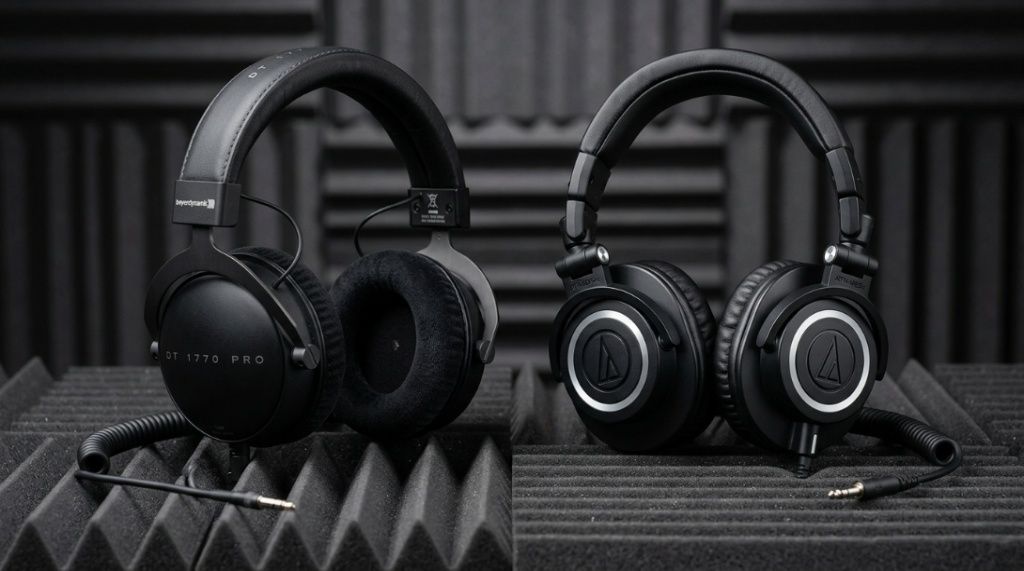
When setting up your monitoring chain, it is crucial to understand how different industry standards shape your mix. While exploring Sennheiser’s lineup gives you a clear picture of reference audio, comparing them against other iconic gear helps contextualize their performance. For a deep dive into how competing industry icons handle tracking and frequency response, check out our breakdown of Studio Workhorses: DT 1770 Pro vs ATH-M50x, which highlights the subtle nuances that separate these classic tools from open-back reference models.
FAQ
Which Sennheiser headphone is best for mixing music at home?
The HD 600 for pure accuracy or HD 650 for comfortable extended sessions. Both deliver professional mixing results. If budget is constrained, the HD 560S at $150 produces genuinely professional-quality mixes while saving $100-200 for other studio needs. The HD 600 remains the most universally recommended single mixing headphone in professional audio.
Can I use Sennheiser HD 600 without a headphone amplifier?
You can, but you shouldn’t. At 300 ohms, the HD 600 needs more current than most budget interfaces provide. Without adequate amplification: bass becomes loose and poorly defined, volume ceiling is low, and dynamic range compresses. You lose the accuracy you paid for. Budget $100-110 for a Schiit Magni or JDS Atom to hear what the HD 600 actually sounds like properly driven.
Is the Sennheiser HD 660S2 worth the upgrade over the HD 600?
It depends on your needs. The HD 660S2 improves bass extension (reaching deeper with more authority) and slightly refines treble smoothness. For modern music with significant sub-bass content (hip-hop, EDM, pop), the HD 660S2’s low-end improvement is meaningful. For acoustic, classical, and vocal-focused work, the HD 600 remains equally capable. The $150-200 price premium is justified for bass-heavy genre mixing.
Are Sennheiser headphones good for producing electronic music?
Excellent — with model selection awareness. The HD 600’s bass roll-off below 50 Hz means sub-bass in electronic music is slightly underrepresented. The HD 660S2 or HD 650 with their extended low-end serve electronic producers better. For EDM, trap, and bass-heavy genres specifically, pair any Sennheiser with occasional subwoofer checks or use a bass-extension plugin for headphone monitoring.
Should I buy genuine Sennheiser replacement pads or aftermarket?
Genuine pads maintain the original sound signature. Aftermarket pads (Dekoni, Brainwavz) often alter the sound — some intentionally (more bass, different treble character). For reference monitoring where consistency matters, always use genuine Sennheiser pads. For casual use or intentional sound tuning, quality aftermarket pads are acceptable alternatives at lower cost.
How do I know if my Sennheiser headphones are genuine and not counterfeit?
Buy from authorized retailers (Sennheiser direct, Amazon sold by Sennheiser, B&H, Sweetwater, Guitar Center). Verify the serial number on Sennheiser’s website. Counterfeit indicators: unusually low price, poor print quality on box, mismatched serial numbers, and driver performance that doesn’t match published specs. If the price seems too good to be true, it probably is.
Can Sennheiser HD 280 Pro be used for both recording and mixing?
For recording: excellent — it’s one of the best isolation headphones at any price. For mixing: functional but limited. The closed-back design restricts soundstage, and the clinical tuning is less revealing of spatial details than open-back models. It works for rough mixing and editing, but critical mix decisions benefit from an open-back complement. Consider it your recording headphone and add an HD 560S or HD 600 for dedicated mixing.
Key Takeaways
- ✅ The best Sennheiser headphones for studio quality sound depend on your primary task — HD 600 for mixing accuracy, HD 650 for long-session comfort, HD 280 Pro for recording isolation
- ✅ Sennheiser’s 300-ohm studio headphones require proper amplification ($100-250 additional) to deliver their full performance
- ✅ The HD 560S at $150 is genuinely professional-grade and the best entry point for home studios on a budget
- ✅ Sennheiser’s repairability means a 10-year+ lifespan at $65/year total cost — cheaper long-term than replacing inferior headphones
- ✅ The HD 600 remains the industry reference after 25+ years — mixes checked on it communicate accurately across the professional world