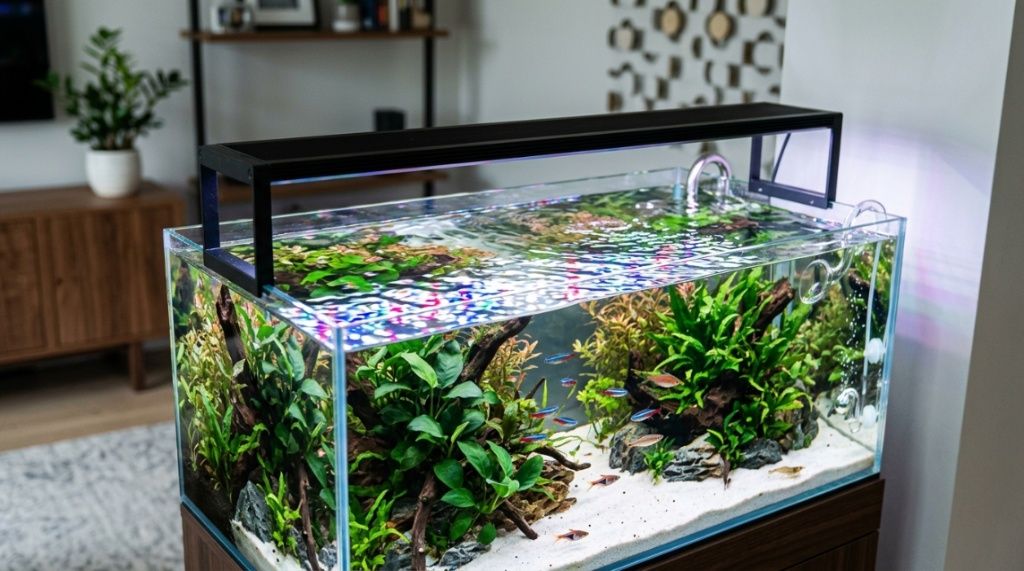

You wake up, flick on the light switch over your fish tank, and within an hour you notice a haze of green water forming. Or maybe your plants are looking pale and leggy. If you have ever wondered if your tank is getting too much—or not enough—light, you are not alone. The single most common mistake new aquarists make is guessing the photoperiod. Understanding how to manage your aquarium LED lights is not just about visibility; it is the foundation of a healthy aquatic ecosystem.
The problem is that there is no one-size-fits-all answer. The ideal duration depends on whether you keep live plants, the type of aquarium you own, and the intensity of your fixture. Let’s cut through the confusion. This guide will give you the exact timing, the science behind it, and the practical steps to dial in the perfect schedule for your specific setup.
What Is the Ideal Daily Photoperiod for a Standard Aquarium?
For a standard community tank with artificial plants or no live flora, keeping your aquarium LED lights on for 6 to 8 hours per day is optimal. This duration supports the natural circadian rhythms of your fish without promoting excessive algae growth. Any longer, and you invite green water and hair algae; any shorter, and your fish may become stressed or lose color.
The 8-hour rule serves as a safe baseline. However, you should adjust this based on the specific needs of your tank. High-intensity lights in a shallow tank may require only six hours, while a deep planted tank with demanding species may need a full eight to nine hours with a midday rest period. Start at the lower end and observe your tank for two weeks before making changes.
Why 8 Hours Is the Sweet Spot
Most fish species originate from tropical waters that experience roughly 12 hours of daylight. Why then do we recommend less? Because artificial lighting is often more intense than natural sunlight penetrating the water surface. Additionally, a shorter photoperiod reduces the window in which algae can photosynthesize, giving your plants a competitive edge.
How Long Should Lights Be On for a Planted Aquarium?
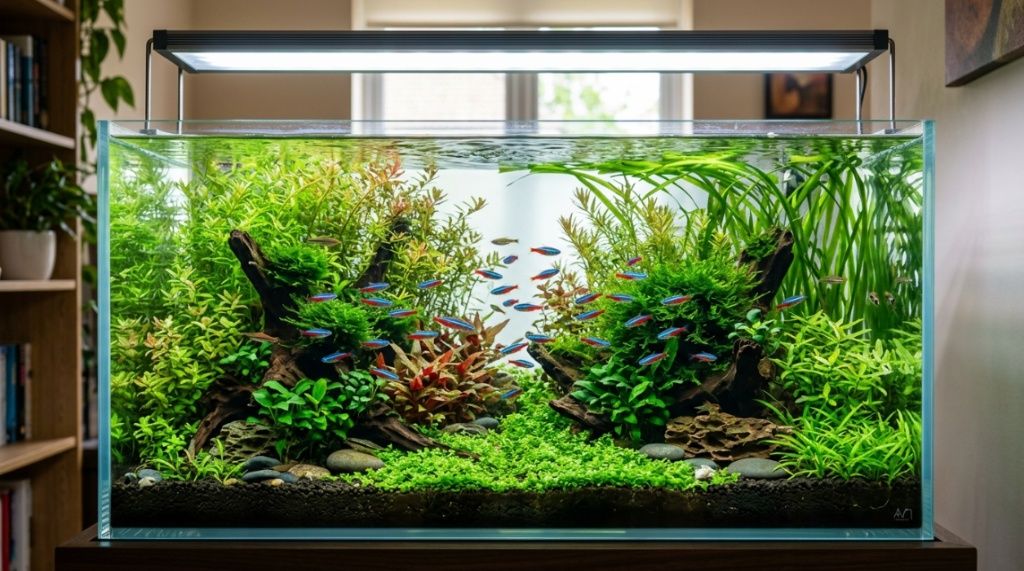
Planted aquariums require a photoperiod of 8 to 10 hours per day, but the exact duration depends on your plant species and CO2 levels. Low-tech tanks (no injected CO2) do best with 6 to 8 hours to avoid algae outbreaks. High-tech tanks with pressurized CO2 can handle 8 to 10 hours because the plants are actively outcompeting algae for nutrients.
Here is a practical breakdown:
- Low-light plants (Java Fern, Anubias, Crypts): 6–7 hours
- Medium-light plants (Amazon Swords, Vallisneria, Rotala): 7–9 hours
- High-light plants (Monte Carlo, Glossostigma, carpeting plants): 9–10 hours (with CO2)
One of the best aquarium LED lights aquarium lighting tips is to use a timer to automate this schedule. Consistency is far more important than trying to manually turn lights on and off at the same time every day.
Can You Leave Aquarium Lights On 24/7?
No, you should never leave aquarium lights on 24/7. Doing so will disrupt the natural day-night cycle of your fish, stress them out, suppress their immune systems, and trigger a massive algae bloom within days. Fish need darkness to rest, just like humans. Even algae-eating species require a dark period for their own biological processes.
Leaving lights on continuously also leads to fluctuating pH levels. Plants and algae produce oxygen during the day but consume oxygen at night. Without a dark period, your tank’s oxygen levels can drop dangerously low when the lights are finally turned off, potentially suffocating your fish.
What Is the Siesta Method for Aquarium Lighting?
The Siesta method involves splitting your photoperiod into two segments with a 2 to 4 hour dark break in the middle. For example: lights on from 7:00 AM to 12:00 PM, off from 12:00 PM to 3:00 PM, then on again from 3:00 PM to 8:00 PM. This mimics tropical midday cloud cover or heavy rain, which naturally suppresses algae growth.
This technique works exceptionally well for planted tanks struggling with algae. The dark break interrupts the algae’s photosynthesis cycle while allowing slower-growing plants to continue absorbing nutrients. It also allows the CO2 levels to build back up naturally during the dark period, which benefits low-tech planted setups.
Pros and Cons of the Siesta Method
| Pros | Cons |
|---|---|
| Reduces algae significantly | Inconsistent viewing time during the day |
| Better CO2 utilization in low-tech tanks | May confuse fish if not done consistently |
| Prevents temperature spikes from lights | Requires a timer capable of multiple on/off cycles |
How Does Light Intensity Affect the Recommended Duration?
Light intensity directly dictates how long you should run your lights. A low-output LED bar running at 20 lumens per liter can safely run for 10 hours. A high-output LED fixture delivering 60 lumens per liter may cause algae within 6 hours. You must match your photoperiod to your light’s PAR (Photosynthetically Active Radiation) levels.
As a general rule:
- Low intensity (0.15–0.5 watts per gallon): 10–12 hours
- Medium intensity (0.5–1.0 watts per gallon): 8–9 hours
- High intensity (1.0–2.0+ watts per gallon): 6–7 hours
If you are unsure of your fixture’s intensity, start with 7 hours per day at the lowest brightness setting. Increase by 30 minutes each week while monitoring for algae growth. The moment you see green spot algae or hair algae on the glass, dial the duration back by one hour.
What Happens If You Leave Aquarium Lights On Too Long?
Leaving your aquarium lights on for more than 10 to 12 hours triggers a cascade of problems. The most immediate issue is algae. Green water, hair algae, and cyanobacteria thrive in extended light periods because they can absorb energy faster than most aquarium plants. Algae will outcompete your plants for nutrients and CO2, leading to plant decline.
In addition to algae, fish suffer from chronic stress. Without a proper dark cycle, fish cannot produce melatonin, which regulates sleep, immune function, and stress responses. Stressed fish become more susceptible to ich, fin rot, and other diseases. You may also notice behavioral changes like erratic swimming, hiding, or loss of appetite.
How Many Hours of Light Do Fish Actually Need?
Fish do not require light for survival in the same way plants do. However, they do need a consistent day-night cycle to regulate their internal clocks. A photoperiod of 8 to 10 hours of light followed by 14 to 16 hours of total darkness is ideal for most freshwater tropical fish. This cycle allows them to feed, rest, and breed naturally.
Some species, such as nocturnal catfish or loaches, prefer dimmer conditions. If you keep these fish, consider using moonlight LED strips or very low-intensity blue lights during the viewing hours. These simulate moonlit conditions and allow nocturnal activity without disrupting the dark period for diurnal fish.
Should You Use a Timer for Aquarium LED Lights?
Yes, using a timer is non-negotiable for achieving consistent, reliable lighting. Manual operation leads to errors—forgetting to turn lights off, leaving them on all weekend, or inconsistent photoperiods that confuse plants and algae alike. A simple digital timer costs less than $15 and will pay for itself in reduced algae treatments and plant replacements.
When setting your timer, choose a block of time that matches your viewing habits. Most aquarists prefer lights on during the afternoon and early evening when they are home. For example, a schedule of 2:00 PM to 10:00 PM works well for people who come home from work and want to enjoy their tank. Avoid turning lights on and off multiple times manually as this stresses fish.
How Do You Transition a Tank to a New Lighting Schedule?
Sudden changes in photoperiod stress both fish and plants. To transition your tank to a new lighting schedule, adjust the duration by 30 minutes every three days. If you are reducing from 12 hours to 8 hours, cut 30 minutes off the end time every three days until you reach your target. This gives your biological filter and plant metabolism time to adapt.
If you are increasing the photoperiod (for example, moving from 6 hours to 9 hours for a new planted tank), add 15 minutes per day. Monitor closely for algae during the first two weeks. If you see diatoms or green spot algae, pause the increase for a few days before continuing.
When Should You Reduce Aquarium Lighting Hours?
You should immediately reduce your lighting hours if you notice any of these warning signs:
- Green water – a sign of free-floating algae blooming due to excess light
- Hair algae forming on plants and hardscape
- Cyanobacteria (blue-green slime) on the substrate
- Plants showing signs of light burn (yellowish or translucent leaves)
- Fish hiding or skittish behavior
- Temperature rising more than 2°F during the photoperiod
Reduce by one full hour and wait two weeks. If symptoms persist, also consider reducing light intensity by dimming or raising the fixture. Sometimes the problem is not duration but intensity, and cutting hours alone will not fix it.
Do Blue or Moonlight LEDs Count Toward the Photoperiod?
Blue or moonlight LEDs used for nighttime viewing do not count toward your main photoperiod. These low-intensity lights emit a wavelength that does not drive significant photosynthesis or algae growth. You can safely run blue lights for 1 to 2 hours after your main lights turn off for evening viewing without harming your schedule.
However, avoid using bright blue or actinic lights for extended periods. Some aquarium LEDs have a “blue” setting that is actually quite intense. If your fish show signs of stress or you notice algae growth during moonlit hours, reduce the blue light duration or intensity. A good rule is to keep moonlights on for no more than 2 hours per night.
Frequently Asked Questions
How many hours of light do betta fish need?
Betta fish need 8 to 10 hours of light per day combined with 14 to 16 hours of complete darkness. This mimics their natural tropical habitat and supports healthy coloration and activity levels. Bettas do not need special lighting, but a consistent schedule prevents stress.
Can I use a timer for my aquarium LEDs?
Yes, timers are highly recommended for aquarium LED lights. They ensure consistent photoperiods, prevent algae from irregular lighting, and automate your tank maintenance. Most digital or mechanical timers work perfectly with standard LED fixtures.
Is it okay to leave aquarium lights off for a few days?
It is safe to leave aquarium lights off for 2 to 3 days if you are treating an algae outbreak or performing maintenance. Healthy fish can handle a few days of darkness without issues. However, live plants will begin to suffer after 3 to 4 days without light.
Do LEDs cause more algae than fluorescent lights?
LEDs do not inherently cause more algae, but their high intensity and coverage can promote algae if used incorrectly. The key is matching your photoperiod and intensity to your tank’s needs. Properly managed LED lighting reduces algae compared to outdated fluorescent tubes.
What is the best time of day to run aquarium lights?
The best time is whatever aligns with your viewing schedule. Most aquarists set lights to come on in the early afternoon and shut off in the late evening. This allows several hours of prime viewing after work and mimics natural daylight cycles for fish.
Should I run a CO2 system with longer lighting hours?
Yes, if you run your lights for 9 to 10 hours, you almost certainly need pressurized CO2 injection. Without supplemental CO2, plants cannot keep up with the increased photosynthesis demand, and algae will take over. Low-tech tanks should stick to 6 to 8 hours to avoid this imbalance.
Can I use a phone app to control my LED lights?
Many modern LED fixtures offer app-based controls for scheduling, dimming, and color adjustments. These apps are convenient but always have a backup mechanical timer in case of Wi-Fi or app failures. Reliable physical timers prevent lighting mishaps during network outages.
Getting your aquarium lighting right comes down to balance. Start with 8 hours for most tanks, observe your fish and plants closely, and adjust based on what you see. Remember that consistency beats perfection. A timer, a reliable LED fixture, and a bit of patience will give you a thriving, algae-free aquarium that you can enjoy every single day.
Finding the right balance for your lighting schedule depends heavily on your budget and what you are growing. If you are managing a saltwater setup on a budget, you don’t need to break the bank to get great results; learn how to set up Budget Reef Aquarium Lighting Without Harming Corals to keep your tank thriving without overspending.