
You’ve probably seen them strapped to car roofs, or maybe you’ve rented a rigid board at the beach and loved it. Now you’re thinking about buying your first paddle board, and the big question is whether to go for a solid epoxy board or an inflatable one. The market has shifted dramatically, and an inflatable paddle board for beginners is no longer the compromise it used to be. In fact, for most newcomers, it’s the smartest and most practical option available. This guide explains why, when an inflatable makes sense, what to look for, and the limitations you need to know about before you click “buy.”
Key Takeaways
- Inflatable boards are easier to transport, store, and handle than hard boards, making them ideal for first-time owners with limited space or vehicle size.
- Modern drop-stitch construction makes inflatables durable, rigid enough for most conditions, and comfortable for beginners learning basic paddling skills.
- Inflatable boards are not the best choice for high-performance surfing, racing, or heavy river use—knowing those limits helps you choose correctly.
- Quality varies significantly by price; look for high material density, strong glue lines, and a proper warranty instead of just a low price.
- Consider the total cost of ownership, not just the board itself—a quality pump and paddle are essential to a good first experience.
Why Inflatables Have Become the Standard First Board
The most direct answer is yes. An inflatable paddle board is a good choice for the vast majority of beginners. If you’re just getting into the sport and you’re not sure how often you’ll go out, an inflatable offers a lower barrier to entry and a much simpler ownership experience. Gone are the days when inflatables were pool toys or floppy, unstable platforms. The modern version uses drop-stitch technology, which creates an internal grid of thousands of polyester threads connecting the top and bottom layers. When inflated to the correct pressure, the board becomes stiff and structurally sound. The result is a board that closely mimics the feel of a solid board while offering practical benefits that hard boards simply can’t match.
If you are still on the fence about which style to purchase, you may want to look at a specific example of an inflatable paddle board for beginners to see what a modern, quality model includes. However, the decision to go inflatable is just the first step—you still need to understand the specs and features that distinguish a good experience from a frustrating one.
The Real Benefits for a New Paddler
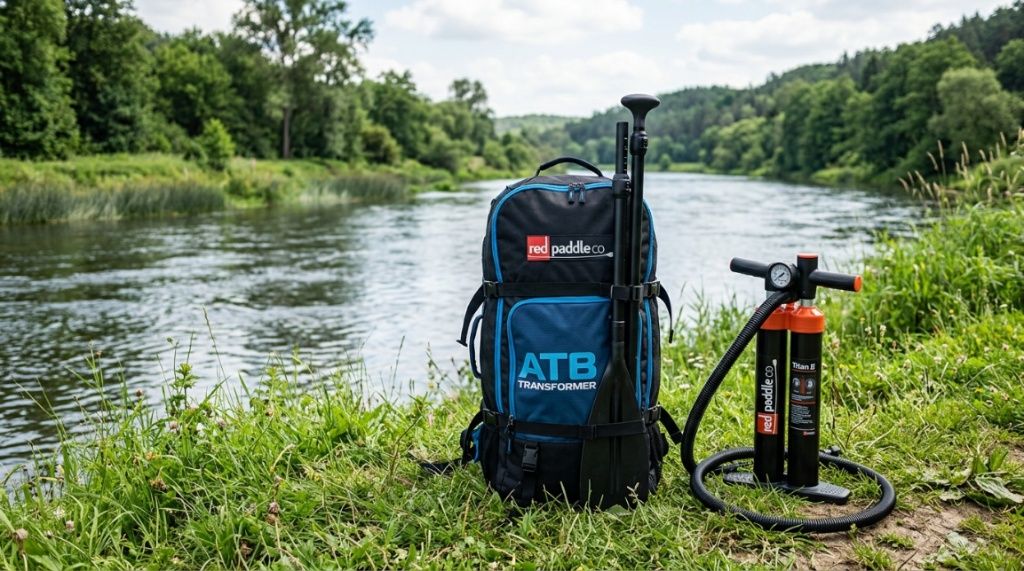
For a beginner, the biggest advantages are practical rather than performance-based. An inflatable board rolls up into a backpack roughly the size of a large duffel bag. This means you can fit it in the trunk of a compact car, take it on an airplane, or store it in a closet without building a roof rack or dedicating garage space to a large, rigid object. This convenience removes the friction of getting on the water, which matters a lot when you are learning and building a habit. If it takes too much effort to get the board to the water, you’ll probably paddle less.
Inflatables also allow you to buy a complete kit. Unlike a hard board, where you need to purchase a roof rack system separately and worry about dings during transport, an inflatable kit includes the board, a pump, a paddle, and a fin. This all-in-one package is much simpler for someone who doesn’t yet know what accessories they need. Furthermore, the softer outer surface means you won’t damage your board if you accidentally drag it over sand or bump into a dock. You also don’t have to worry about leaving it in the sun briefly while you take a swim; the material won’t crack like a fiberglass board might.
How an Inflatable Compares to a Hard Board
It is important to understand the trade-offs. A hard epoxy or fiberglass board generally has a higher maximum speed and slightly better glide efficiency because the hull doesn’t flex and the rails hold a sharper shape. However, that performance difference is mostly noticeable to intermediate and advanced paddlers who are trying to cover long distances at a steady pace or chasing race times. For a beginner who is learning to balance, turn, and manage basic strokes, this difference is negligible. In fact, the slight flex in an inflatable can be forgiving on your joints and make the board feel less twitchy in low wind conditions.
| Feature | Inflatable Board | Hard Board (Epoxy) |
|---|---|---|
| Durability | High (resists dents, scratches; soft landing) | Low to moderate (prone to cracks and chips) |
| Portability | Excellent (fits in a backpack) | Poor (needs roof racks or large vehicle) |
| Storage Space | Minimal (can fold into a closet) | Large (requires a room or garage wall space) |
| Glide & Speed | Good (slight flex) | Excellent (stiffer hull) |
| Setup Time | 5–10 minutes (requires inflation) | Ready immediately |
| Weight | Heavier than expected (16-25 lbs) | Lighter on average (20-30 lbs) |
| Stability for beginners | Generally wider, more forgiving | Varies heavily by design |
| Best Use Case | Calm lakes, sheltered bays, casual paddling | Racing, surfing, long-distance touring |
Is the Rigidity Really Enough?
One of the first concerns beginners raise is that an inflatable will feel like a “pool toy” and be wobbly. This concern is outdated. If you inflate the board to the recommended PSI, which is usually between 12 and 15 PSI depending on the brand, the board becomes incredibly taut. You can stand on the center of the board and it will barely sink. The reason people have bad experiences with “floppy” inflatables is almost always because they under-inflate the board. A board pumped to only 8 PSI will feel soft, flex in the middle, and track poorly. Always use the air pump pressure gauge to hit the target PSI. This is a non-negotiable rule for getting good performance from your purchase.
Choosing the Right Inflatable for Your Needs
Not all inflatable boards are created equal. If you are looking at a budget model that costs $200 less than the average, you need to look closely at the build quality. The term “military-grade PVC” is used loosely. Look for a board with a heavier material weight (measured in mil, such as 1000 mil) which indicates better puncture resistance. More importantly, check the warranty—a solid company will back their board for at least two years against manufacturing defects. Also consider the included paddle; if it is a cheap plastic one, you will replace it quickly, adding to your total cost.
Key Specifications for a Beginner
When you search for an inflatable paddle board for beginners, you will see many options claiming to be perfect for novices. The main factors that actually make a board ideal for you are:
- Width: For a beginner, look for a board at least 32 inches wide. This provides maximum lateral stability. Narrower boards (30 inches or less) are faster but require more balance skill.
- Thickness: Always choose a 6-inch thick board. Thinner boards (4.75 inches) cannot hold as much stiffness and may sag under heavier paddlers.
- Length: Standard boards are around 10’6″ to 11’6″. For a general beginner on lakes and rivers, 10’6″ is highly maneuverable, while 11’6″ glides better and tracks straighter for longer tours.
- Fins: Look for either a single large fin or a tool-less (slide-and-click) fin system. Removable fins are better for shallow water, but you must ensure they lock securely to avoid instability.
- Weight Limit: Check the maximum capacity. It is usually between 275 and 350 lbs. Even if you weigh 150 lbs, do not underestimate gear weight (water, cooler, phone, paddle) and always leave a 20% buffer for safety.
When Should You Avoid an Inflatable?
There are genuine scenarios where an inflatable is not the best tool. If your primary goal is surfing in oceanic waves, a hard board will allow you to catch waves earlier and carve tighter turns. An inflatable board tends to bounce on choppy faces, making it harder to maintain speed on steep drops. Similarly, if you plan on paddling long distances, like 8 to 10 miles regularly in wind, the added flex of an inflatable forces you to use more energy than you would on a hard touring board. Finally, if you are paddling in a river with rocks, inflatables can puncture if struck sharply, though they are more resistant to blunt force impact than fiberglass. For these niche uses, a specialized hard board is a better investment.
Step-by-Step: Setting Up Your First Inflatable
Once you buy an inflatable, you need to know how to properly set it up to avoid damage. The number one reason inflatable boards fail is “over-inflation” during a hot day or “under-inflation” during use. Follow these steps to get the best performance:
- Unroll and Lay Flat: Allow the PVC to warm up if it’s cold. Cold PVC is brittle. Lay the board flat on a non-abrasive surface, not on pavement or gravel.
- Insert the Fin: Attach the fin before inflation. This is much easier before the board is tight, as the fin boxes align more naturally.
- Inflate to High PSI: Use the pump. If it’s a double-action pump, you will get air on both the up and down strokes. The pressure will feel hard to achieve near the end—this is normal. Do not stop at “plenty full.” Use the gauge until it reaches the recommended PSI (often 15 PSI).
- Check Rigidity: Push your thumb into the center. It should feel like a drum head—no visible dimpling. If it dimples, it needs more air.
- Secure the Paddle: Adjust the paddle length. A good rule is to have the handle reach your wrists when your arms are straight up over your head.
Common Mistakes to Avoid
The most common issue is dragging the board across concrete while it is partially deflated. This creates abrasions that weaken the material over time. Always use the backpack straps, or lift the board completely off the ground when moving it. Another mistake is leaving it “rolled up” in the backpack for weeks in a hot car. The pressure from the tightly packed folds can cause creases that eventually crack. If you aren’t using it, unroll it and store it loosely on its edge to extend the lifespan, For extra storage tips before heading out to the water, read our guide on how to choose the right gear: check out our guide on Find a Safe Surfboard Roof Rack.
How Much Should You Spend?
Price is a strong indicator of quality in the inflatable board sector. A beginner board under $300 often has thin PVC, cheap, flexible plastic fins, and a manual pump that takes 20 minutes to fill the board. You want to invest in a kit that ranges from $450 to $700. At this price point, you typically get a laminated (not just printed) design, a high-quality aluminum shaft paddle, and a dual-chamber or high-efficiency hand pump. Buying a reliable brand also means that the manufacturing process uses stronger epoxy glue for the seams, which prevents air leaks—the most common reason inflatables end up in the trash.
Frequently Asked Questions
Is an inflatable paddle board harder to balance than a hard board?
No. In fact, most inflatables marketed toward beginners are actually wider (32 inches or more) than their hardboard counterparts. The slight cushioning effect of the air chamber can also reduce the impact of minor balance corrections. Hard boards that are thin and narrow are more challenging, but these are performance-oriented, not beginner-oriented. Properly inflated to 15 PSI, an inflatable will feel just as stable as a hard board.
Are inflatable paddle boards puncture-proof?
No. They are highly resistant to abrasion and blunt impacts, but they are not immune to sharp objects like rusty rebar, barnacles, or fishing hooks. However, a puncture is different from a blowout; it tends to cause a slow leak. Small pinholes can be repaired with a PVC repair kit (glue and patch), usually included with the board, and the board remains usable for years after a proper fix.
How long does it take to inflate a paddle board?
With a standard hand pump, you can expect inflation to take between 7 and 12 minutes, especially to reach high PSI. If you want to speed this up, you can purchase an electric air pump—which usually costs an extra $50–$80—that can inflate the board to 15 PSI in under 3 minutes. The downside of a handheld pump is the physical effort required near the final PSI, not the time itself.
Can I use an inflatable paddle board in the ocean?
Yes, but with caution. Inflatable boards float well and are perfectly safe in calm ocean waters and gentle swells. However, they are not recommended for breaking surf conditions where waves are over three feet tall. The light weight and flexible nose make them prone to being knocked around by whitewater and strong currents. Always use a leash in the ocean to avoid losing the board if you fall.
How should I clean my inflatable paddle board?
After every saltwater session, rinse the entire board with fresh water. Pay special attention to the fin box area and the valve. Let the board dry fully before deflating and packing it away. If you store it without washing off the salt, the crystals can abrade the PVC over time and corrode the metal spring valve, leading to air leakage.
Conclusion
Choosing an inflatable paddle board for beginners is not just a good choice; for most new paddlers, it is the best choice. It offers the greatest combination of value, safety, and convenience. You trade a tiny bit of glide performance on the water for a massive improvement in storage and transport off the water. By focusing on critical specifications like width and thickness, buying from a reputable brand with a warranty, and committing to correctly inflating your board every time, you will have a reliable piece of gear that serves you well for years or until you decide to specialize in a specific discipline. If your goal is to enjoy the water, explore, and build your skills, start with a high-quality inflatable and don’t overthink it—get out there and paddle.