
How to Find the Best Induction Cooktop for Safety: Why the Safest Induction Cooktop 1800W Matters

You have just unpacked your new portable induction burner. You plug it in, place a pan on the glass surface, and hold your breath. Will it overheat? Will it shut off automatically if you forget about it? For many home cooks, the leap from gas or electric coils to induction technology brings excitement but also genuine worry. You want speed and precision, but you refuse to compromise on safety especially if you have kids, pets, or a tiny kitchen. The problem is that not all induction cooktops are built with the same safety standards.
What Makes an Induction Cooktop Safe?
An induction cooktop is inherently safer than gas or electric coil stoves because it generates heat directly in the pan rather than on the burner surface. However, safety features vary dramatically between models. A truly safe induction cooktop includes thermal overload protection, automatic pan detection, residual heat indicators, child lock functionality, and over-temperature shutoff. These five features work together to prevent burns, fires, and electrical hazards. Understanding each one helps you separate reliable units from dangerous knock-offs.
Thermal Overload Protection Explained
Thermal overload protection prevents the internal electronics from exceeding their safe operating temperature. If the cooktop runs for too long or the ventilation is blocked, this sensor cuts power before components melt or catch fire. Look for a model that explicitly lists “overheat protection” in the specifications.
Automatic Pan Detection and Shutoff
Induction cooktops only work with ferromagnetic pans. Automatic pan detection means the burner turns off immediately when you remove the pan. This feature prevents accidental activation if a dish towel or utensil falls onto the cooktop surface. High-quality sensors detect the pan within one to two seconds.
Residual Heat Indicators and Child Lock
Even after the cooktop turns off, the glass surface stays hot for several minutes. Residual heat indicators display a warning symbol until the surface cools below 60°C. A child lock feature disables all buttons, preventing curious little hands from turning the burner on accidentally.
Why Is 1800W the Sweet Spot for Portable Induction Safety?
An 1800-watt induction cooktop delivers enough power to boil water quickly and sear meat properly while staying within the limits of standard household electrical circuits. Most residential kitchens use 15-amp or 20-amp breakers. An 1800W unit draws approximately 7.5 to 8 amps, leaving headroom for other appliances. This wattage also produces less thermal stress on internal components compared to 2000W or 2200W models, reducing the risk of overheating and prolonging the cooktop’s lifespan. For portable units specifically, 1800W provides the best balance between cooking performance and electrical safety.
Electrical Circuit Compatibility
Plugging a high-wattage appliance into a circuit shared with a refrigerator, microwave, or toaster can trip your breaker. An 1800W cooktop rarely causes nuisance trips when used on a dedicated circuit. Always verify your kitchen outlet supports at least 15 amps before purchasing.
Component Longevity and Heat Management
Internal capacitors, power boards, and cooling fans last longer when they operate within their design limits. Manufacturers of the safest induction cooktop 1800W invest in higher-grade components and larger heat sinks compared to budget units pushing higher wattages.
Real-World Cooking Performance
With 1800W, you can bring two quarts of water to a rolling boil in under four minutes. You can also hold a steady low simmer for delicate sauces. This wattage range gives you versatility without the risk of scorching your pans or your dinner.
Which Safety Certifications Should You Look For?
Safety certifications prove that a cooktop has passed independent testing for electrical, fire, and health hazards. The most important certifications include ETL, UL, CE, and FCC compliance. ETL and UL listings indicate the product meets North American safety standards. CE marking covers European Union requirements. FCC compliance ensures the cooktop does not emit harmful electromagnetic interference. Never purchase an induction cooktop that lacks at least one of these certifications.
ETL vs. UL: Which One Matters Most?
(Electrical Testing Labs) and UL (Underwriters Laboratories) both test to the same ANSI/UL standards. certification is often less expensive for manufacturers, but both are equally valid. Look for the mark on the product itself or in the user manual.
Why CE and FCC Compliance Still Matter for US Buyers
Many imported cooktops carry CE marks but lack ETL or UL certification. While CE indicates basic safety, it does not guarantee compatibility with US electrical systems. FCC compliance is important because induction cooktops generate electromagnetic fields. Certified models limit EMF emissions to safe levels.
How Does Build Quality Affect Safety?
The physical construction of an induction cooktop directly impacts its safety. A flimsy plastic casing, poorly sealed electronics, or a thin glass surface can lead to electrical shorts, shattered glass, or fire. Safe cooktops use a reinforced ceramic glass top, a robust metal or high-temperature plastic housing, and sealed internal compartments that block moisture and dust ingress.
Glass Thickness and Impact Resistance
Look for Schott Ceran or EuroKera glass, which are industry standards for durability. These glass surfaces withstand thermal shock, such as placing a cold pan on a hot burner, without cracking. Cheaper glass may shatter under similar conditions.
Ventilation Design and Overheating Prevention
Induction cooktops generate heat that must be expelled through fans and vents. A well-designed unit has intake vents on the bottom or side and exhaust vents that direct hot air away from the controls. If ventilation is blocked, the cooktop may overheat and shut down permanently.
Cord Quality and Plug Type
A safe induction cooktop uses a thick, grounded power cord rated for at least 15 amps. The plug should be a standard three-prong NEMA 5-15. Avoid units with thin cords, two-prong plugs, or detachable power cables that can loosen during use.
Can an Induction Cooktop Catch Fire?
Yes, but the risk is extremely low compared to gas or electric coil stoves. Induction cooktops do not use open flames or red-hot heating elements. However, a fire can occur if the unit malfunctions, if flammable materials sit on the burner, or if the cooktop is plugged into a faulty outlet. The built-in safety features of a quality induction cooktop reduce fire risk substantially. Over-temperature sensors, automatic shutoff, and flame-retardant materials provide multiple layers of protection.
Common Causes of Induction Cooktop Fires
- Using a damaged or frayed power cord
- Operating the cooktop on a surface that blocks ventilation
- Spilling flammable liquids into the air intake
- Leaving plastic or paper items on the burner
- Using the cooktop with a pan that is too small for the burner
How to Minimize Fire Risk
Always place the cooktop on a flat, heat-resistant surface away from curtains and paper towels. Keep the ventilation openings clear. Inspect the cord before each use. Never leave the cooktop unattended while cooking with oil or grease.
What Features Make a Cooktop Kid-Safe and Pet-Safe?
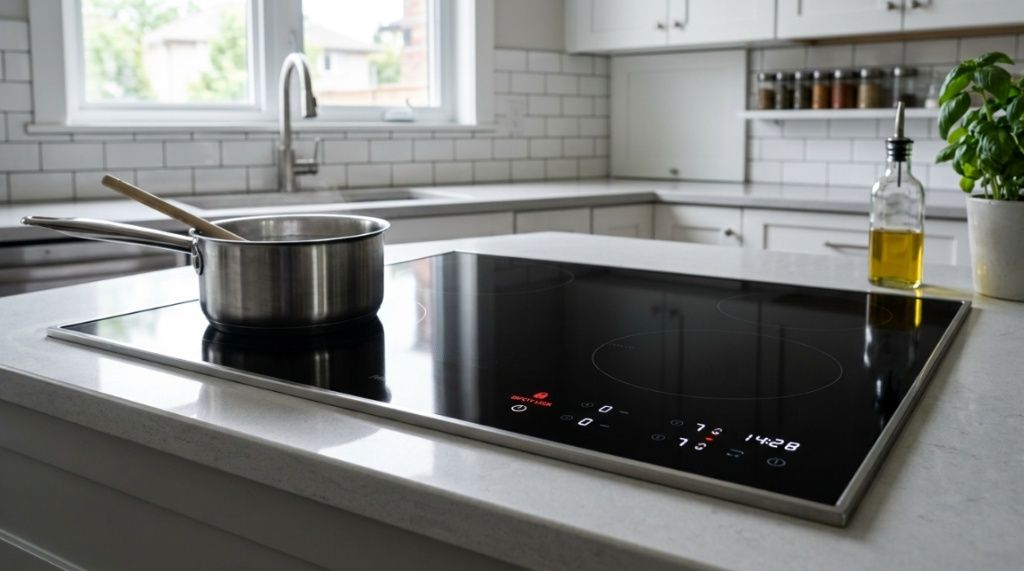
Households with children or pets need extra layers of protection. The most important safety features for these environments include a physical or digital child lock, automatic pan detection, cool-touch housing, and a low-profile design that prevents tipping. Induction cooktops are inherently safer because the glass surface stays cooler than electric coils, but it still gets hot enough to cause burns.
Child Lock Implementation
A proper child lock disables all buttons and prevents changes to temperature settings. Some models require a specific combination of buttons to unlock, while others use a dedicated slide or toggle. Test the child lock before buying to ensure it is not easily bypassed.
Cool-Touch Housing and Edge Guards
The sides of the cooktop should remain cool during operation. Plastic or metal edges that get hot can cause burns if a child leans against them. Edge guards or raised bezels also prevent spills from running directly into ventilation slots.
Stability and Anti-Slip Feet
Portable induction cooktops can slide on smooth countertops. Look for models with rubberized anti-slip feet that grip the surface firmly. A unit that shifts during cooking could tip, spill hot food, or pull the cord from the outlet.
How to Test an Induction Cooktop for Safety Before Buying
You cannot always test a cooktop in a store, but you can evaluate its safety by reading the manual, checking online reviews, and inspecting the physical product. Start by looking for the safety certifications on the box or in the product listing. Then, read user reviews that mention overheating, shutoff problems, or electrical issues. Finally, if you can see the unit in person, check the build quality of the cord, the glass, and the housing.
Check the User Manual for safety warnings.
Manufacturers that prioritize safety include detailed warnings about ventilation, pan size, and circuit requirements. A thin manual that glosses over safety may indicate a low-quality product.
Look for Third-Party Safety Reviews
Consumer advocacy groups and independent YouTube reviewers often test cooktops for overheating, shutoff accuracy, and EMF emissions. Search for reviews that specifically discuss safety, not just cooking performance.
Inspect the Power Cord and Plug
A thick, flexible cord with a molded plug suggests quality manufacturing. A thin cord with a removable plug or a plastic shroud that slides easily should raise red flags.
Which Brands Consistently Produce Safe Induction Cooktops?
Several brands have earned reputations for prioritizing safety in their induction cooktop designs. Duxtop, Nuwave, and Gourmia are popular for portable models. For built-in units, Bosch, GE, and Samsung lead in safety innovation. When shopping for a portable unit specifically, look for brands that emphasize safety certifications, child locks, and thermal protection in their product descriptions.
Duxtop Safety Reputation
Duxtop portable induction cooktops typically include ETL certification, child locks, and automatic pan detection. Their 1800W models are widely regarded as among the safest budget-friendly options.
Nuwave and Precision Temperature Control
Nuwave cooktops offer precise temperature control and multiple safety sensors. However, some users report that the child lock feature is not as intuitive as other brands. Always confirm the specific safety features of the exact model you are considering.
Gourmia and Smart Safety Features
Gourmia integrates smart shutoff timers and residual heat warnings into many of its units. Their cooktops tend to have larger ventilation areas, which helps prevent overheating during extended use.
What Maintenance Keeps an Induction Cooktop Safe?
Regular maintenance preserves the safety features of your induction cooktop. Clean the glass surface after each use to prevent food debris from interfering with pan detection. Inspect the ventilation slots for grease or dust buildup. Periodically test the child lock and automatic shutoff functions. Replace the unit immediately if you notice a cracked glass surface, a frayed cord, or irregular heating behavior.
Cleaning Without Damaging Sensors
Use a soft cloth and a specialized induction hob cleaner. Avoid abrasive sponges or chemical cleaners that can scratch the glass or seep into the control panel. Scratches can interfere with the electromagnetic field and reduce pan detection reliability.
Ventilation Maintenance
Dust and grease accumulate inside the ventilation slots over time. Use a dry toothbrush or compressed air to gently dislodge debris. Never use water or liquid cleaners near the ventilation openings.
When to Replace Your Cooktop
Most induction cooktops last between 8 and 12 years with proper care. Replace the unit if the glass cracks, if the cord becomes hot during use, if the auto-shutoff fails, or if you notice any burning smells during operation.
Frequently Asked Questions
Is an induction cooktop safer than a gas stove?
Yes. Induction cooktops eliminate open flames, reduce the risk of gas leaks, and feature automatic shutoffs that gas stoves lack. The glass surface also cools faster than electric coils.
Can I use any pan with an induction cooktop?
No. Induction cooktops require ferromagnetic pans made of cast iron, stainless steel with a magnetic base, or enameled steel. Aluminum, copper, and glass pans will not work.
Do induction cooktops emit harmful radiation?
Induction cooktops emit low-frequency electromagnetic fields, but within FCC-compliant limits. The field only activates when a pan is present, and exposure decreases significantly with distance. Standing three feet away eliminates measurable exposure.
What should I do if my induction cooktop trips the breaker?
Unplug the cooktop immediately. Check if other high-wattage appliances are on the same circuit. Try plugging the cooktop into a dedicated outlet. If the breaker trips again, the cooktop may have an internal fault and should be replaced.
How do I know if my induction cooktop has a child lock?
Check the control panel for a lock icon or a button labeled “Lock” or “Child Lock.” In the user manual, look for a section titled “Child Safety” or “Control Lock.” Many models require holding the lock button for three to five seconds to activate.
Can a power surge damage an induction cooktop?
Yes. Power surges can damage the internal control board or power supply. Use a surge protector rated for at least 15 amps to protect your cooktop, especially if you live in an area with frequent electrical storms.
Why does my induction cooktop keep shutting off?
Automatic shutoff activates when the cooktop detects no pan, when the surface overheats, or when the timer expires. Check that your pan is magnetic and sufficiently large. Ensure ventilation slots are clear. If the problem persists, the temperature sensor may be faulty.
Conclusion
Choosing an induction cooktop is one of the smartest moves you can make for a safer kitchen. The technology itself eliminates the most dangerous elements of traditional stoves, but the specific model you select determines how well you are protected. Prioritize units with thermal overload protection, automatic pan detection, child locks, and respected safety certifications like ETL or UL. Stick with the 1800W power range for the safest balance of performance and electrical compatibility. Pay attention to build quality, cord integrity, and ventilation design. By verifying these features before you buy, you ensure that your cooktop delivers convenience without compromising your family’s safety. Now that you know what to look for, take the next step. Evaluate your current cooktop against these standards, and if it falls short, upgrade to a model that gives you total confidence every time you cook.